
ENVIRONMENT

Saint-Tropez,
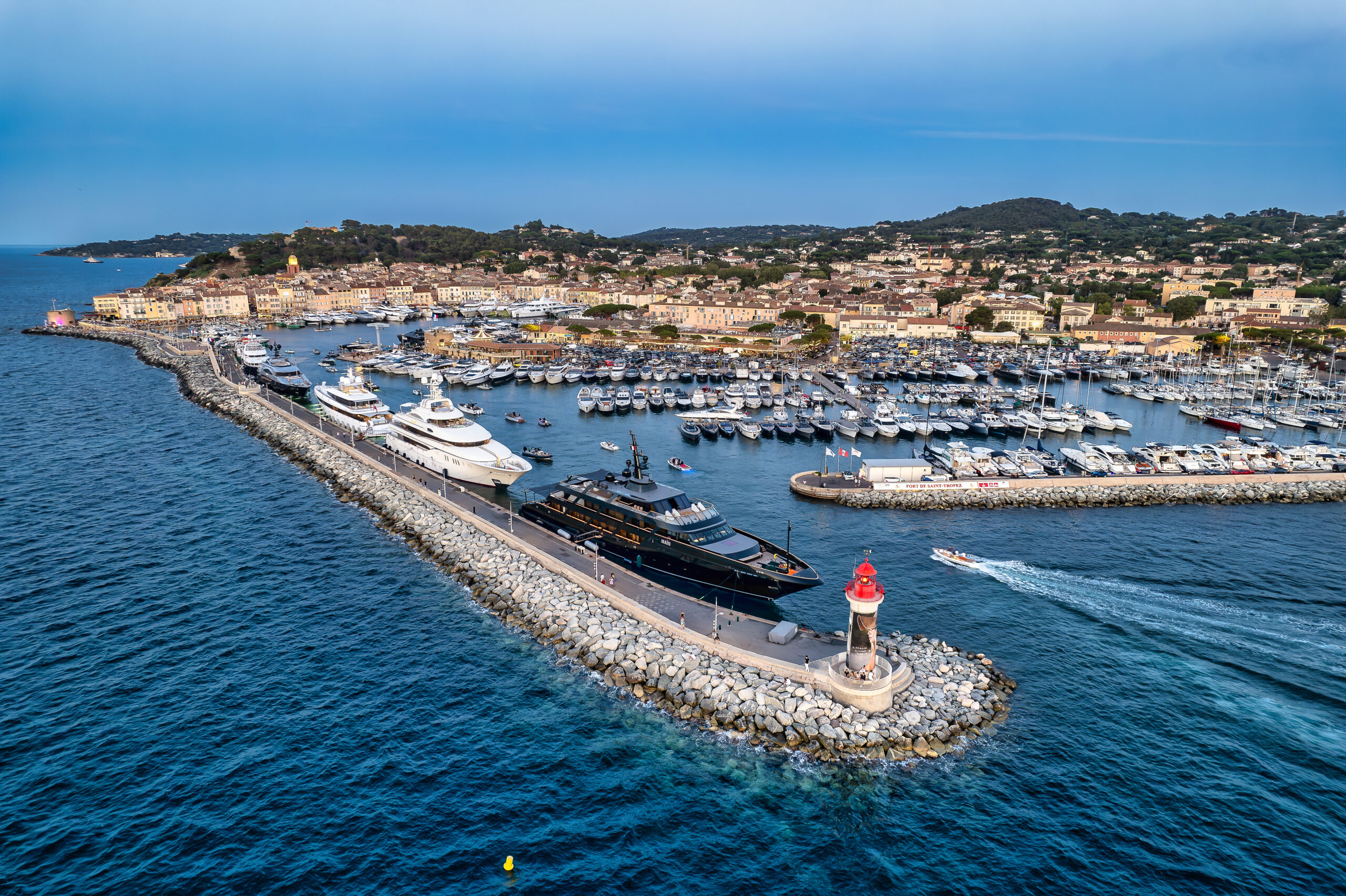
a responsible harbour
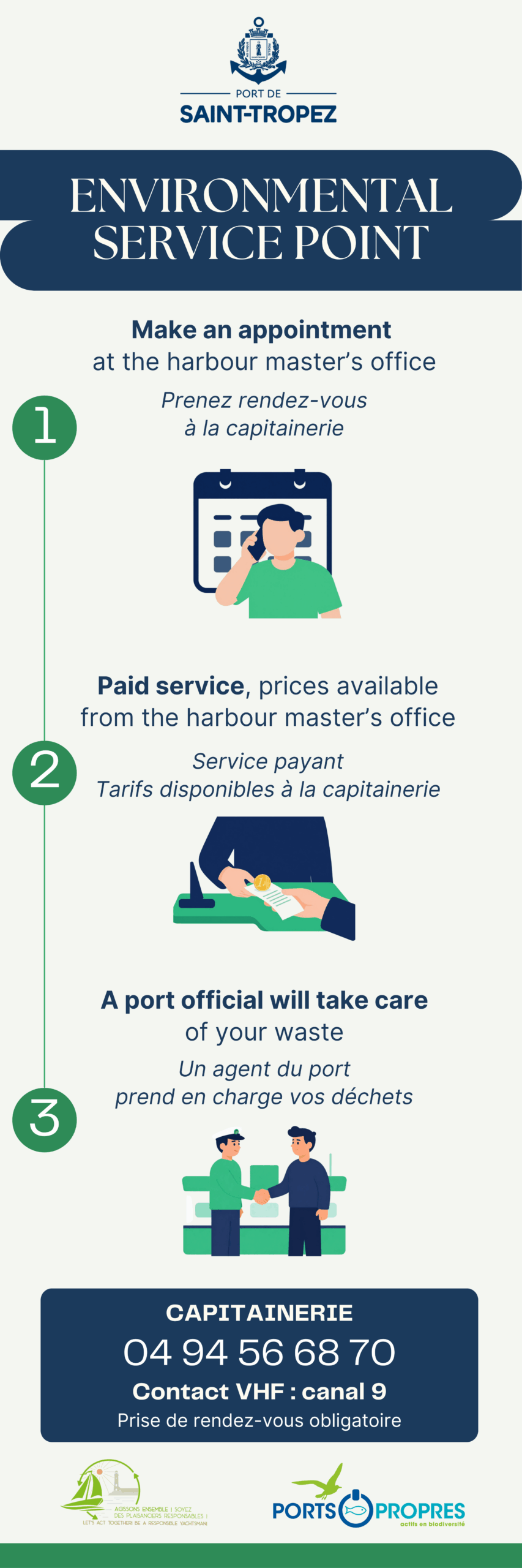
Harbour master’s office services and facilities
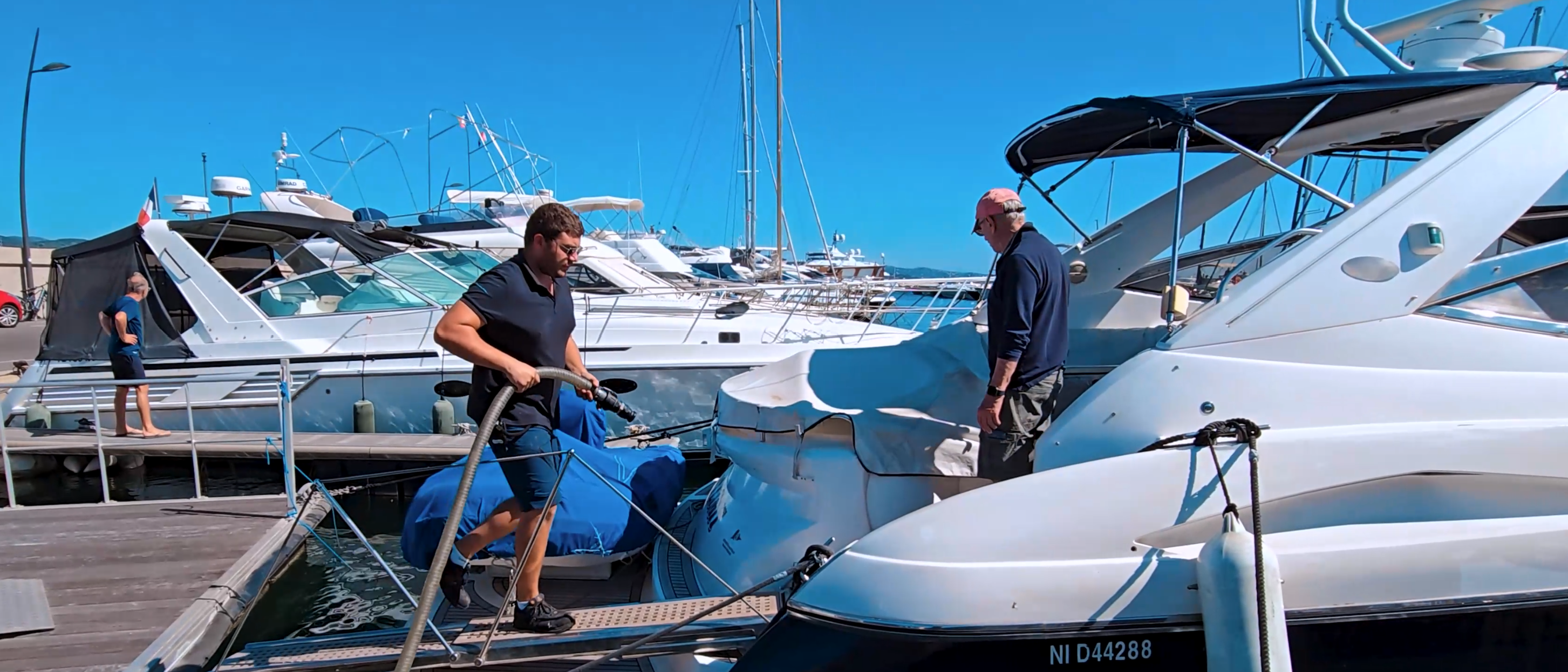
- Free waste water pumping service (gravity and vacuum systems)
- Free bilge water pumping service
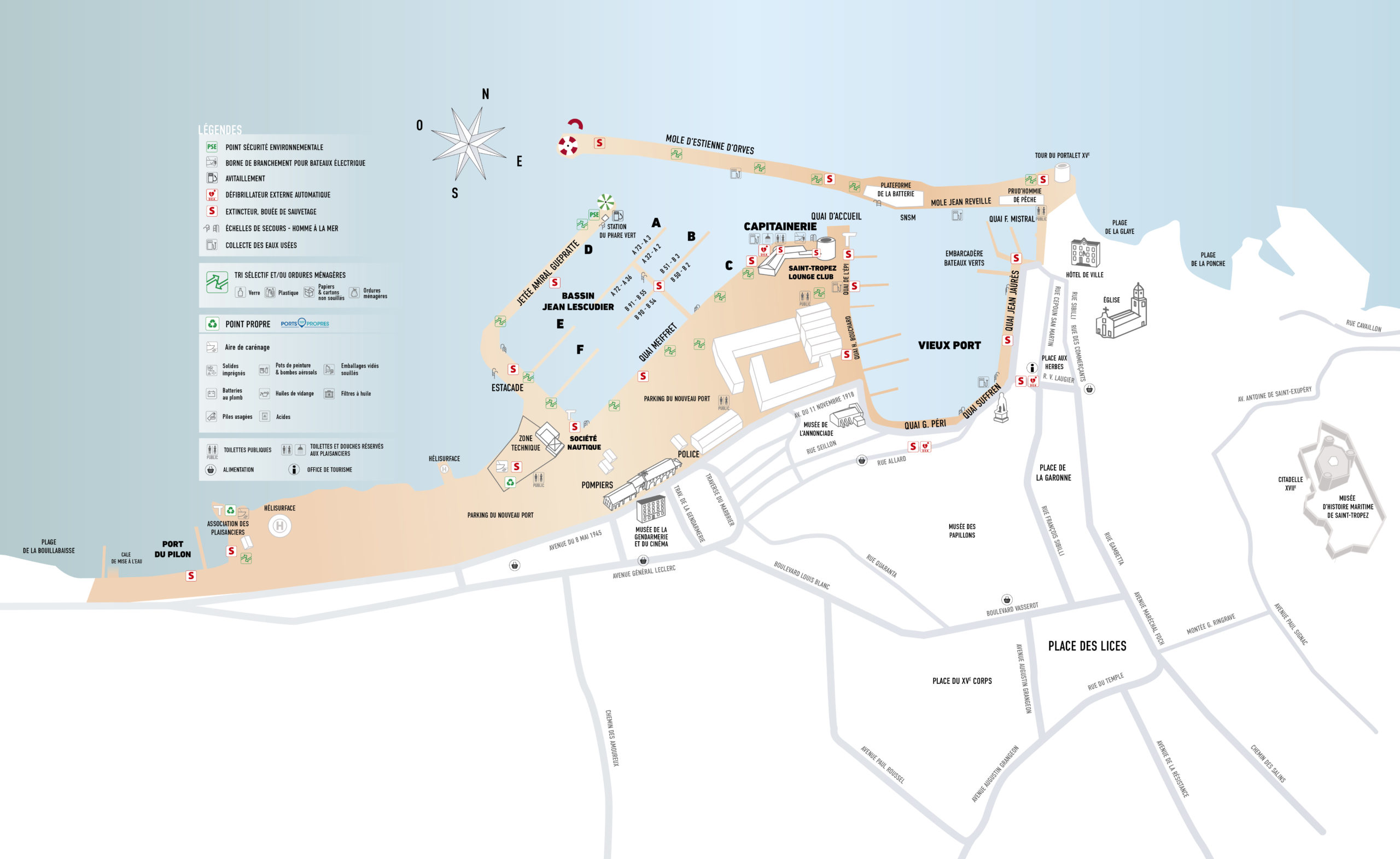
- Waste collection points accessible in several areas of the port for selective sorting of household waste and a clean point for sorting toxic waste
- All the information about your waste collection point is available here.
- Provision of a vehicle to collect used oil cans.
- A dedicated area for ship refitting in the technical zone.
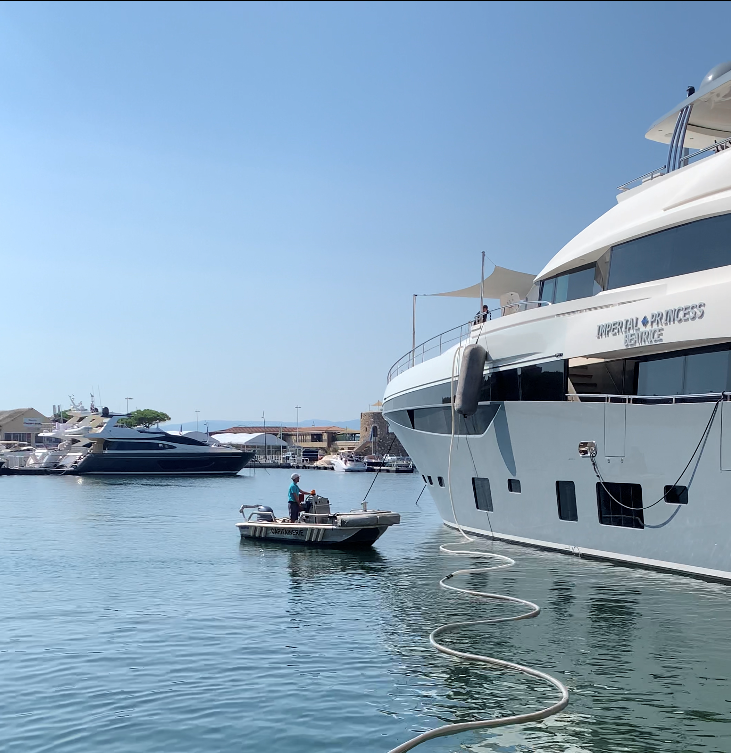
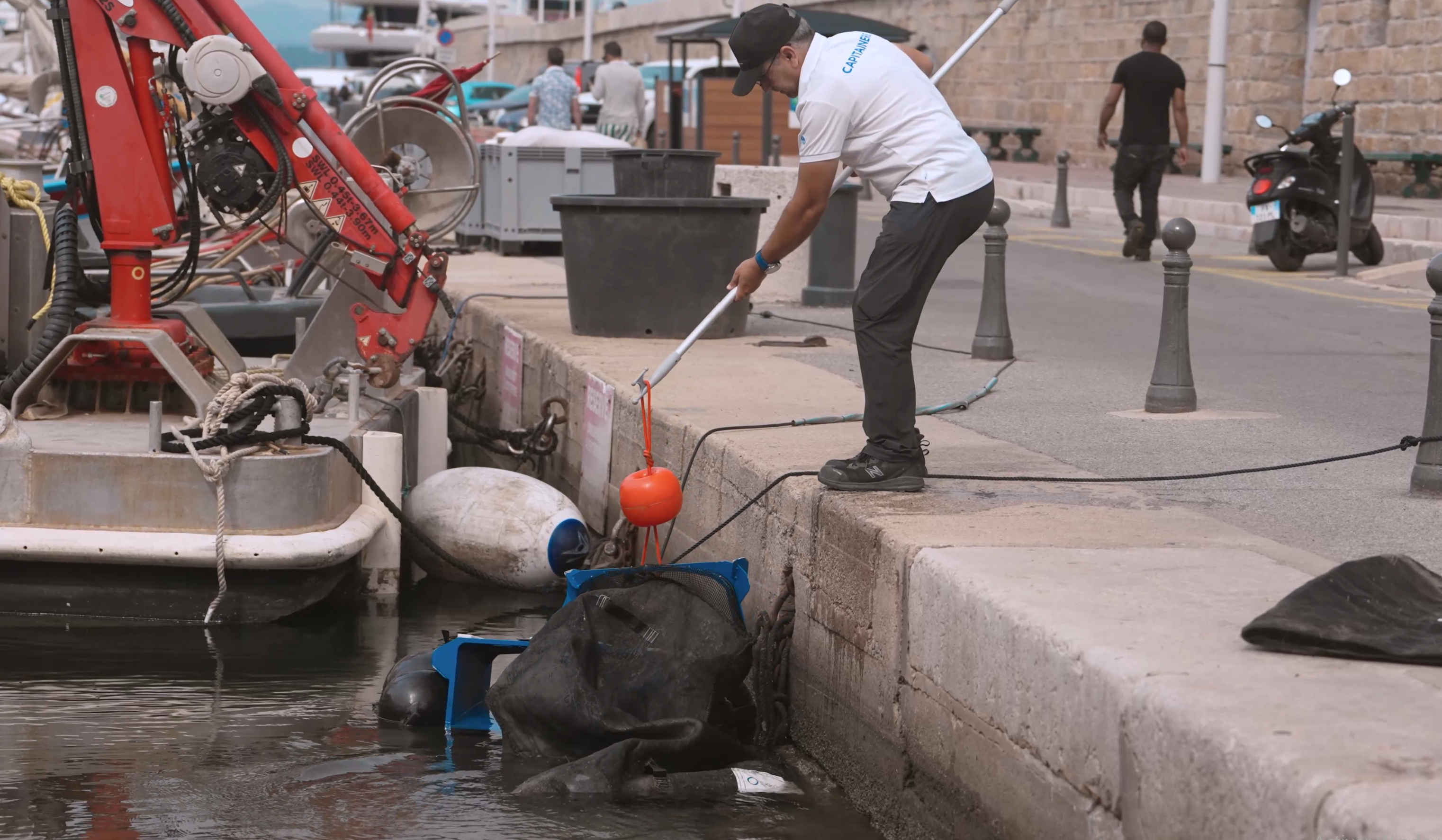
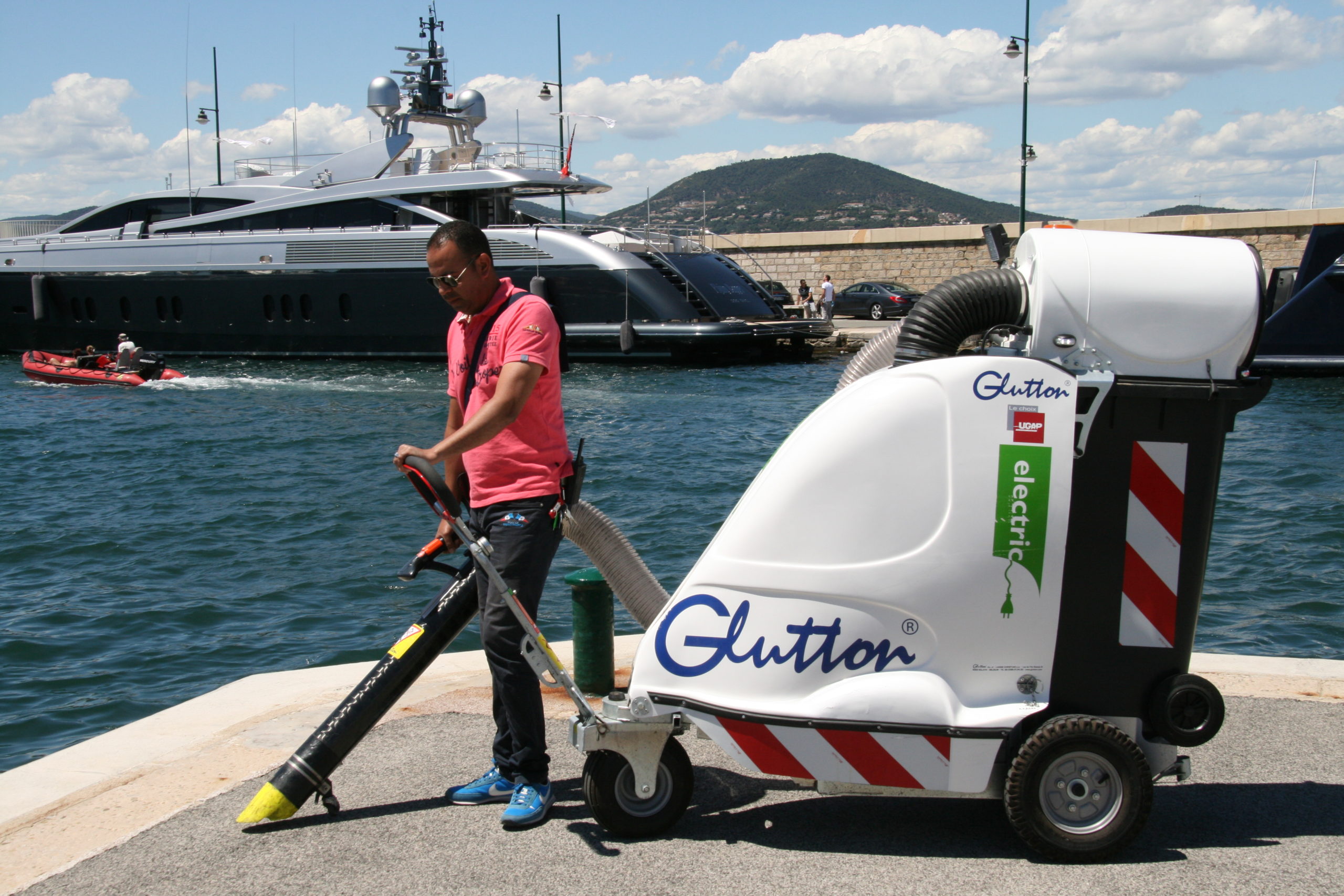
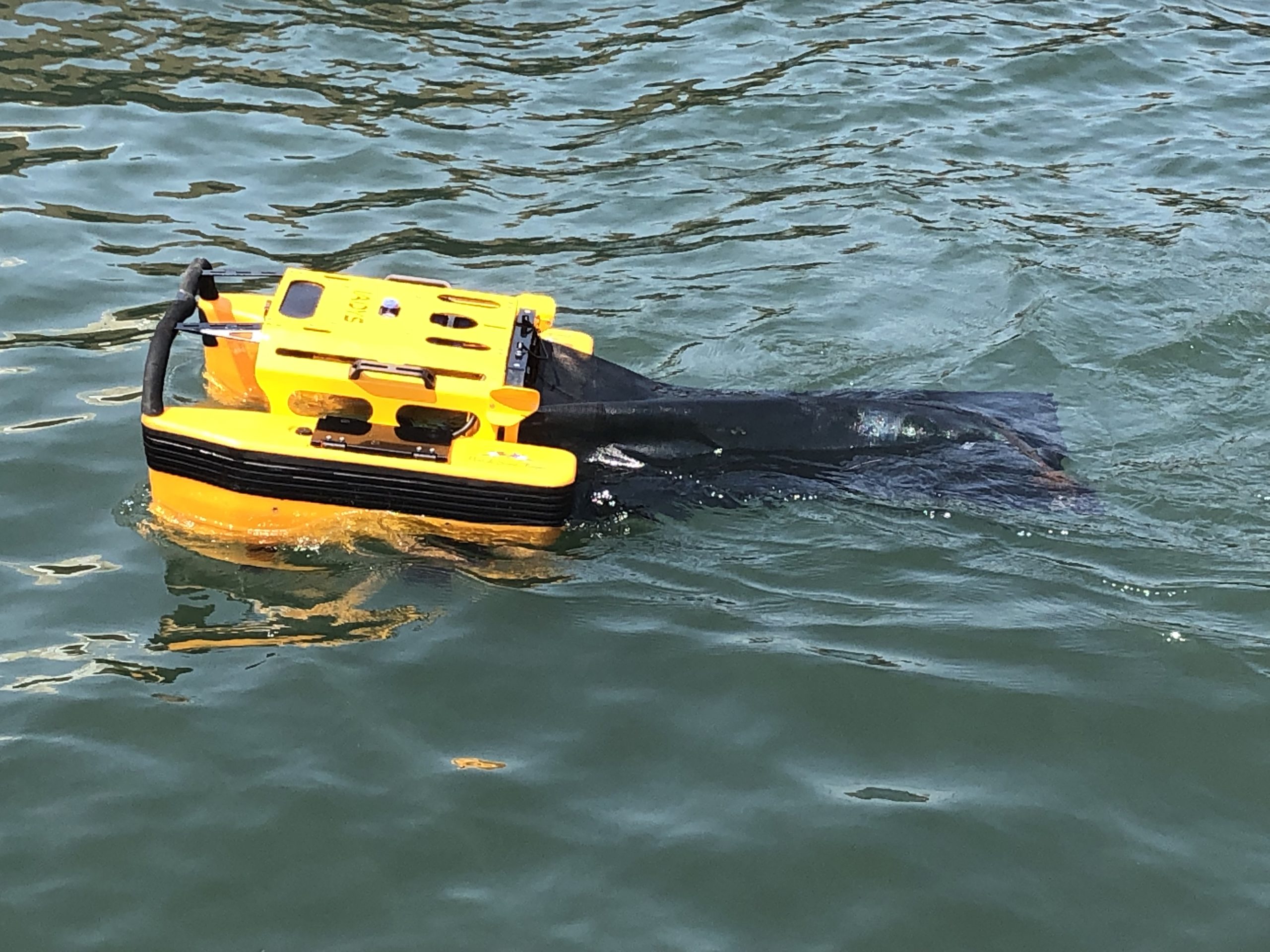
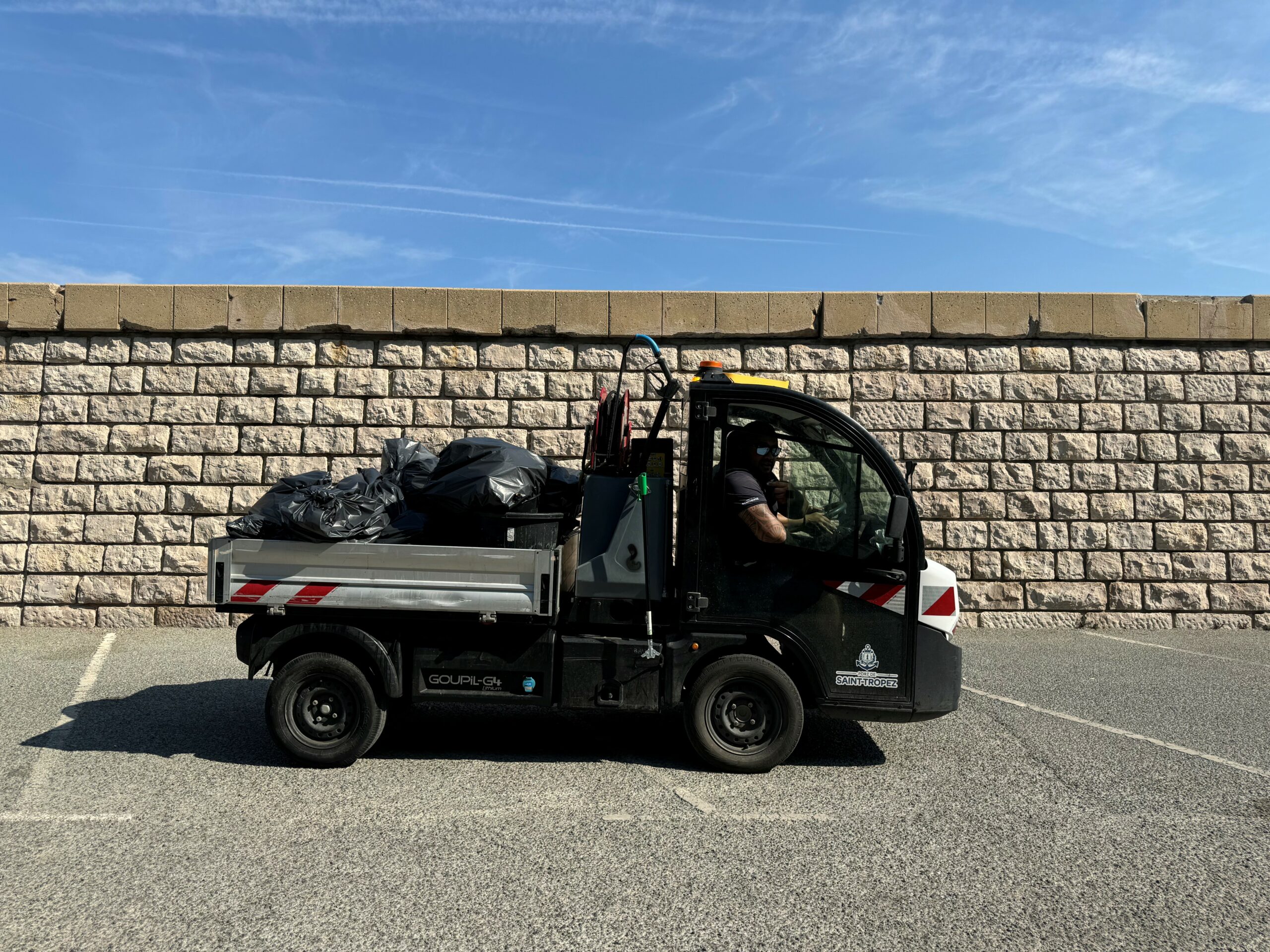
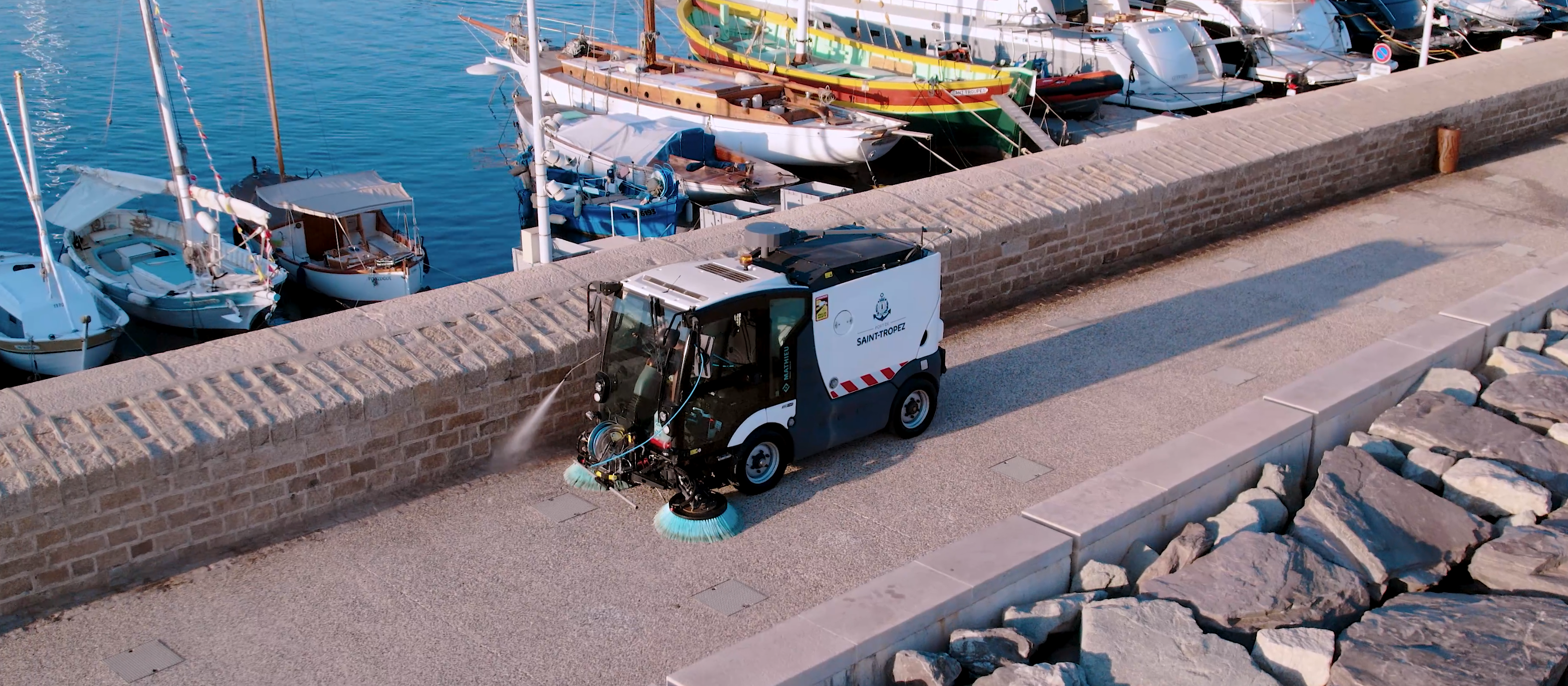
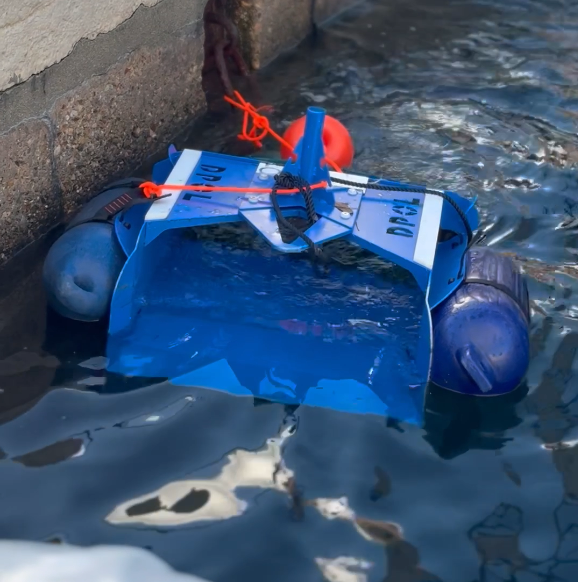
- Daily maintenance of the port by the harbor master’s team on the quays (the glutton) and on the water (piloting the Jellyfishbot).
- Establishment of an environmental safety point (at the green lighthouse station) to facilitate pollution response operations.
- Disposal of used oil: a vehicle is available to collect used oil cans. This operation can also be carried out by a tanker truck (Ecotank).
- An area dedicated to boat maintenance is located in the technical zone.
- Regular cleaning of the quays and port waters by our team.
- Installation of an emergency anti-pollution kit (near the green lighthouse) to be used in the event of a spill to stop and treat pollution.
- There is a household waste collection point (at the slipway) and a toxic waste collection point (in the technical area).
Our efforts towards a committed and more responsible port
for us, for you, for tomorrow!
Committed port
Completion of the environmental diagnostic study. An action plan is drawn up and the first steps are taken.
On 15 December 2023, the port of Saint-Tropez receives its Afnor Ports Propres certification.
On 15 January 2025, the port receives its global Afnor Ports Propres Actifs en Biodiversité certification.
Staff
Staff training: Every year, port agents receive theoretical and practical training on the ‘Clean Ports’ and ‘Clean Ports Active in Biodiversity’ initiatives.
Staff also receive regular training at the harbour master’s office and have access to several files and practical guides in case of an incident.
Anti-pollution exercises are carried out monthly for staff.
Equipment
Acquisition and installation of new equipment to combat chronic pollution:
- The Glutton
- The Jellyfishbot
- 3 DPOL robots
- Wastewater pumping stations installed throughout the port.
- Bilge water collection pump
- Several collection points for sorting household waste and two clean points for sorting toxic waste
- Waste collection at the quayside for ships moored in the port and those at anchor
- Staubli systems installed on the quayside terminals to prevent water wastage
- Use of a BES generator with O3
Communication
A communication and awareness-raising plan for boaters has been put in place through various media by the Port, the town and the Community of Communes of the Gulf of Saint-Tropez.
The port has also established strategic partnerships with committed associations. The port is a partner of Alliance Posidonia, Sea Index and Je Navigue Je Trie.
Infrastructure
Infrastructure redevelopment:
- 2022: refurbishment of the Meiffret quay. New promenade and installation of several recycling points
- 2021: creation of a recycling point at Port du Pilon
- 2020: Installation of signage promoting environmental protection
- 2019-2020: Renovation of the technical area (careening area and clean point) and creation of a unloading area that complies with current standards.
2017: work on the Pilon technical area: creation of a careening area, an unloading area and installation of hydraulic and treatment facilities to recover liquids and waste from careening work.
Pollution
Implementation of measures to combat accidental pollution: installation of five anti-pollution caissons around the port and creation of an environmental safety point located on the green lighthouse jetty. This anti-pollution kit helps to limit the impact of polluting fluids in the port’s waters. The caisson contains blotting paper and a bin for contaminated waste.
In 2023, the port installed two anti-pollution booms at the safety quay and the red lighthouse.
A port clean-up campaign is carried out every year by the port’s team of divers.
In 2024, a ship destruction campaign was also set up to enable shipowners to recycle their ships free of charge.
eco-friendly actions at sea and on land
5 eco-friendly actions to take at sea
1 – Save water and electricity:
Equip yourself with a water gun with an automatic shut-off and unplug your power supply when you are away to better control your water and electricity consumption. Use the port’s sanitary facilities, which are open 24 hours a day (an access code will be given to you at reception) and connected to a collective sanitation system.
2 – Use natural and biodegradable products:
Several brands now offer cleaning products as well as natural and biodegradable hygiene products that are less harmful to the environment.
3 – Sort and collect your waste:
Use the sorting bins provided for this purpose on the quays. A collection point for bulky waste (located at the pier) and a clean point for toxic waste (located in the technical area) are at your disposal. Waste treatment map.
4 – Empty your vessel:
A free waste water and bilge water pumping service is available on request from the harbour master’s office. All discharges and degassing in the harbour waters are prohibited.
5 – Maintain your vessel:
A regularly maintained vessel pollutes less, so it is advisable to have it serviced annually.
For maintenance work on your vessel, only use the authorised areas. The technical area has a careening area equipped with a collection tank for careening residues, two tanks for waste oil and a clean-up point.
DPOL the cleaning robot
The harbour master’s office has three DPOLs from EKKOPOL.
The DPOL is a floating waste pump that works by creating a strong current to suck up floating pollution while remaining stationary if desired. The waste is stored in a removable net. It is a self-contained machine that can operate 24 hours a day.
Guide to preserving our sea
Find out more through the various information sources and channels available at the harbour master’s office, online or via apps.
Choose your anchorage area based on the seabed.
Anchor in a sandy area to avoid seaweed beds.
Ensure you have sufficient chain length and raise the anchor directly below the boat to avoid ‘ploughing’ the seabed.
Do not throw anything into the sea. Keep your rubbish on board until you arrive at the port, where you can sort it and dispose of it in the appropriate containers.
Ecotank: Waste collection service for boats at anchor (July and August).
Caulerpa (taxifolia and racemosa) are invasive species. Take care not to spread them with your anchor, do not throw any fragments into the water, and report them if you see them.
Fishing must be practised responsibly in order to preserve marine resources and the balance of ecosystems.
POSIDONIA
The pivotal ecosystem of the Mediterranean Sea.
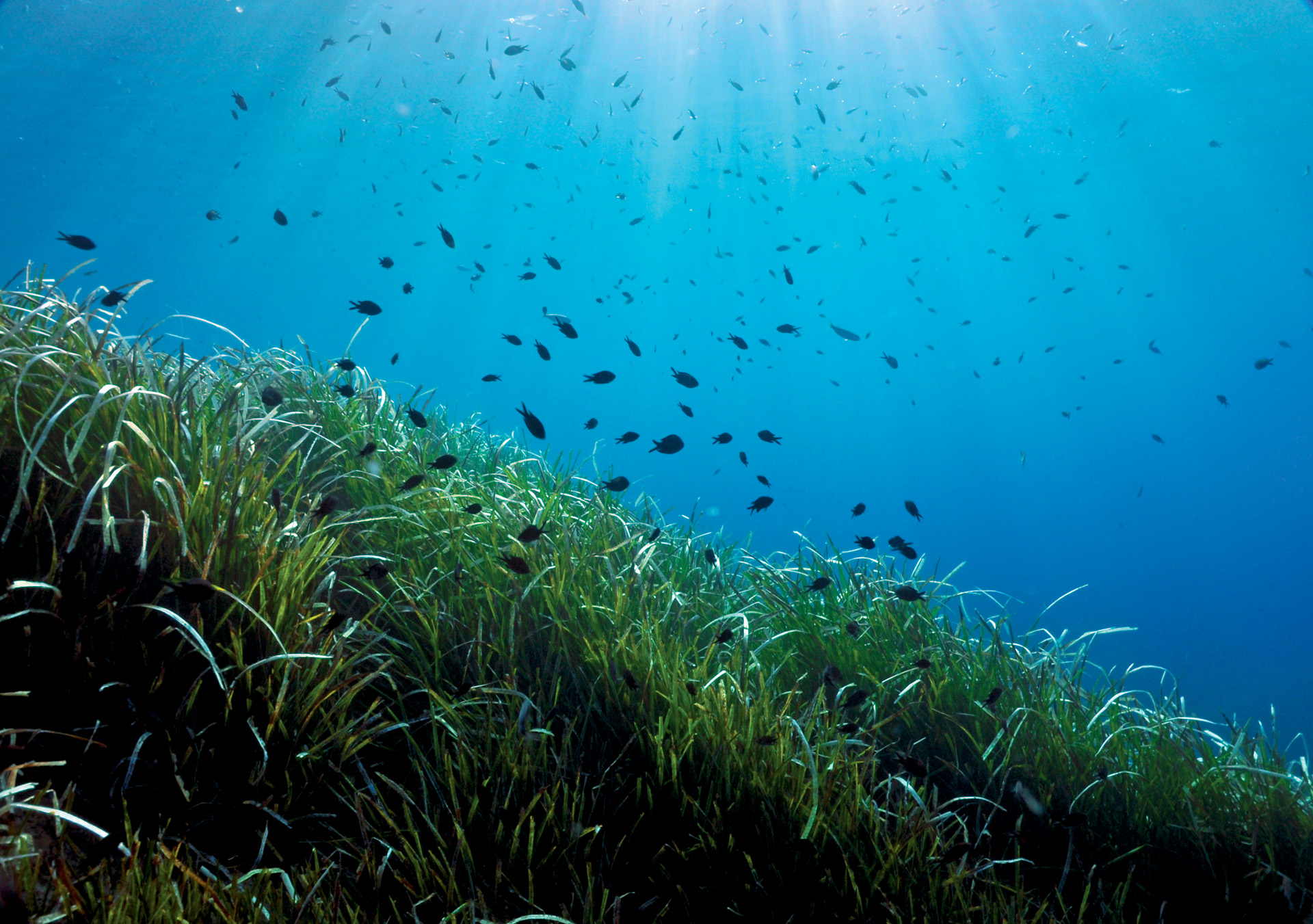
Posidonia seagrass beds are found along the coastline at depths of between 0 and 40 metres. Protected since 1988, this species forms a marine forest that plays an important role in the ecosystem. It provides a habitat for many animal and plant species, produces oxygen and helps protect the coastline from erosion. This species is threatened by recreational boating activities: the discharge of waste water into the sea, the ploughing of the seabed with anchors, pollution, etc.
Several projects and missions are currently being carried out by organisations, but the danger is still present. Be an informed and responsible boater, and practise eco-friendly behaviour.
Pelagos Charter: a strong commitment to maritime protection
On 31 May 2011, Vincent Morisse, Mayor of Sainte-Maxime, welcomed the municipalities of Saint-Raphaël, Saint-Tropez and La Croix-Valmer to sign the Pelagos Partnership Charter with the Maritime Prefect. The four towns thus committed themselves to the preservation of marine mammals in the Mediterranean. The Pelagos Sanctuary (meaning ‘high seas’ in Greek), which came into force on 21 February 2002, was born out of a common desire and a process of consultation between France, Italy and the Principality of Monaco.
The aim is to protect marine mammals (whales, dolphins, sperm whales, etc.) from disturbances caused by human activities in the maritime part of the Corsican-Ligurian-Provençal basin, which covers 87,500 km2, thus reconciling the harmonious development of socio-economic activities with the protection of habitats and species.
downloads